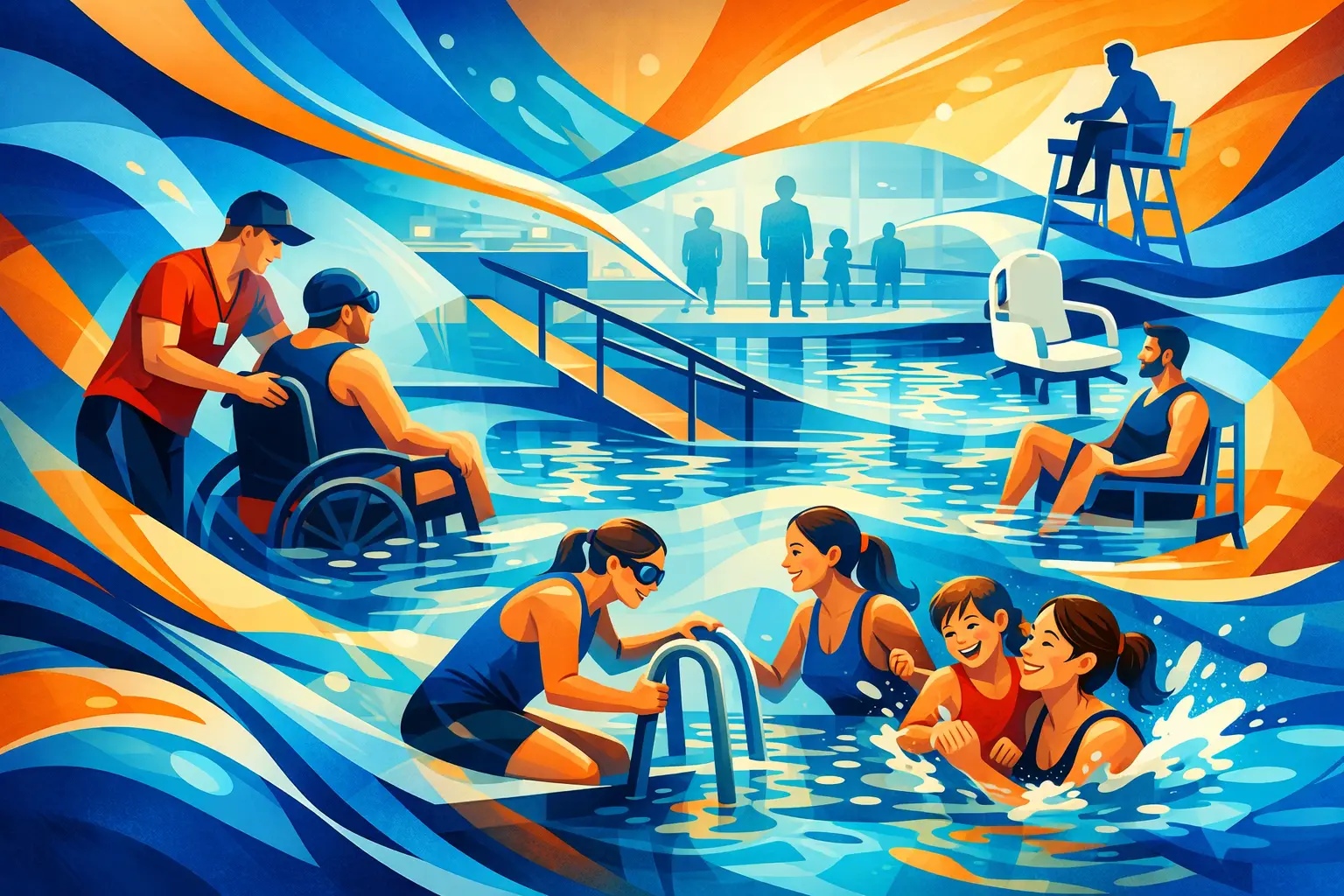
A pool lift installed but unavailable during public swim is not meaningful access. Neither is an accessible entrance that leads to a deck where staff are unsure how to assist a guest, communicate program options, or respond when equipment needs attention. Aquatic accessibility compliance training helps facilities move beyond a checklist toward reliable, respectful access for people with disabilities.
For aquatic directors, operators, parks and recreation teams, school districts, and community leaders, this work connects directly to daily operations. It affects capital planning, staff readiness, program design, customer service, maintenance, and public trust. The goal is not simply to avoid a problem. It is to make the facility and its programs usable by more members of the community.
Accessibility is an operational responsibility
Accessibility is often treated as a construction issue: purchase the right equipment, complete a renovation, and move on. Physical features matter greatly, but they are only one part of the experience. A participant may need a clear route from parking and entry points to the water, an available means of entry, accessible changing areas, and staff who can explain options without assumptions or discomfort.
A facility can have compliant equipment and still create barriers through daily practices. A lift may be stored improperly, blocked by furniture, missing a charged battery, or removed from service without a clear response plan. Registration procedures may not ask participants what support or accommodation they need. Swim lesson policies may be inflexible when a reasonable adjustment could allow a child or adult to participate safely.
This is why training should involve more than the person responsible for facilities. Front desk personnel, lifeguards, instructors, supervisors, maintenance staff, program coordinators, and leadership each influence whether access works in practice. Board members and funding decision-makers also need enough understanding to prioritize repairs, replacements, and improvements before a barrier becomes a crisis.
What aquatic accessibility compliance training should cover
Effective training begins with the distinction between facility access and program access. Facility access concerns the physical environment, including routes, entrances, deck surfaces, restrooms, changing rooms, spectator areas, and ways to enter the water. Program access concerns whether people can actually participate in lessons, lap swim, therapy-related programming, recreation, competition, and community events.
Staff should understand the accessible features at their site and how those features are intended to function. That includes routine inspection, cleaning, charging, testing, documentation, and prompt reporting of equipment concerns. Training should also establish who has authority to remove equipment from service, who contacts a vendor or maintenance provider, and how the facility communicates temporary limitations to patrons.
The strongest programs also address communication. Staff should learn to speak directly with participants, ask what assistance is wanted rather than presume it, and describe available options clearly. Assistance in and around the water should be provided according to facility procedures, staff training, and the participant's preferences. Staff should not be asked to perform duties outside their training or use improvised methods that create risk for either the participant or employee.
A useful course should address at least these five areas:
- Applicable federal accessibility expectations, along with the need to verify state and local requirements.
- Daily readiness of accessible routes, water-entry equipment, and changing or restroom features.
- Respectful communication, customer service, and accommodation-request procedures.
- Program modifications that can expand participation while preserving essential safety standards.
- Documentation, reporting, and leadership accountability for correcting barriers.
The legal and technical details can vary by facility type, age, jurisdiction, renovation scope, and operating model. Training is not a substitute for advice from qualified accessibility, legal, design, or code professionals when a specific compliance question arises. It does, however, help employees recognize issues early and follow a consistent process.
Start with a real-world access review
A written policy is useful, but a walk-through shows how the facility operates when doors open and programs begin. Conduct the review from the perspective of a participant arriving for a typical activity. Follow the route from parking or drop-off through check-in, locker rooms, the pool deck, water entry, and spectator or waiting areas.
Observe during busy periods as well as quiet ones. Temporary barriers are often the ones that affect people most: stacked deck chairs narrowing a route, a hose crossing a pathway, a locked accessible gate, signage placed where it cannot be read easily, or an entry device that has not been checked since the last shift. Include staff in the review so they can connect standards with the conditions they see every day.
The review should also examine the program journey. Can a family identify whom to contact before registering? Do staff know how to route an accommodation request? Are lesson instructors prepared to discuss goals, sensory needs, communication preferences, and water-entry options? Is there a process for determining when additional staffing, adapted equipment, or scheduling changes may be appropriate?
Not every concern has the same solution. A newer municipal facility may need stronger staff procedures, while an older pool may face significant physical limitations and require a phased improvement plan. A competitive program may need to balance event logistics with access for athletes and spectators. The right approach depends on the setting, but delay should not become the default response.
Make training specific to roles and shifts
One annual presentation can establish expectations, yet it rarely creates lasting operational readiness. Accessibility procedures belong in onboarding, supervisor training, shift briefings, equipment checks, and incident or maintenance reporting systems. Staff turnover is common in aquatics, particularly among seasonal teams. A process that depends on one experienced employee is vulnerable from the start.
Front desk staff need practical language for receiving requests and connecting patrons with the right decision-maker. Lifeguards need to know the location and status of access equipment, how to keep routes clear, and when to call a supervisor. Instructors and coaches need guidance on inclusive teaching practices and on maintaining essential safety requirements. Maintenance teams need clear inspection schedules and a way to communicate outages before the public discovers them.
Scenario-based practice makes training more useful. Rather than asking staff to recall a policy slide, present common conditions: a lift battery does not hold a charge before a lesson; a guest asks about joining an adult water fitness class; a deck renovation temporarily changes a route; or an instructor receives a request for a modified lesson format. Discuss the next action, the responsible role, and the documentation required.
Build accessibility into budgets and planning
Facilities that wait for a complaint or equipment failure often face more expensive choices. A planned approach identifies short-term operational corrections, mid-range equipment needs, and long-range facility improvements. It also creates a stronger case when leaders seek capital funding, grants, partnerships, or voter support for aquatic investments.
Budget planning should account for the full life cycle of access features, not only their purchase price. Equipment may require batteries, covers, inspections, parts, service agreements, replacement schedules, and staff training. Renovation planning should include accessibility review early, when changes to routes, locker rooms, entries, and deck layouts are easier to coordinate.
Community input adds value here. Invite participants, families, disability advocates, and program partners to describe where access works and where it breaks down. Their experience can reveal barriers that are invisible on a floor plan or in a policy manual. Listening does not mean every request can be met immediately. It means decisions are informed by the people the facility is meant to serve.
Measure readiness, not just completion
A completed training roster is not the best indicator of success. Leaders should also look for evidence that staff can apply what they learned. Are accessible routes checked and recorded? Is equipment available and functioning when programs begin? Are accommodation requests handled consistently? Are maintenance concerns resolved within a defined process? Do participants know where to ask for support?
Review these indicators regularly with supervisors and leadership. When a barrier is found, focus first on correction and learning rather than blame. Aquatic operations are complex, and conditions change quickly across shifts, seasons, and programs. A culture that encourages staff to report issues early protects both participants and the organization.
Accessible aquatics are not a separate program at the edge of facility operations. They are part of how a community pool fulfills its purpose: creating a place where more people can learn, exercise, compete, recover confidence in the water, and belong. Consistent training gives teams the practical foundation to make that promise real each day.