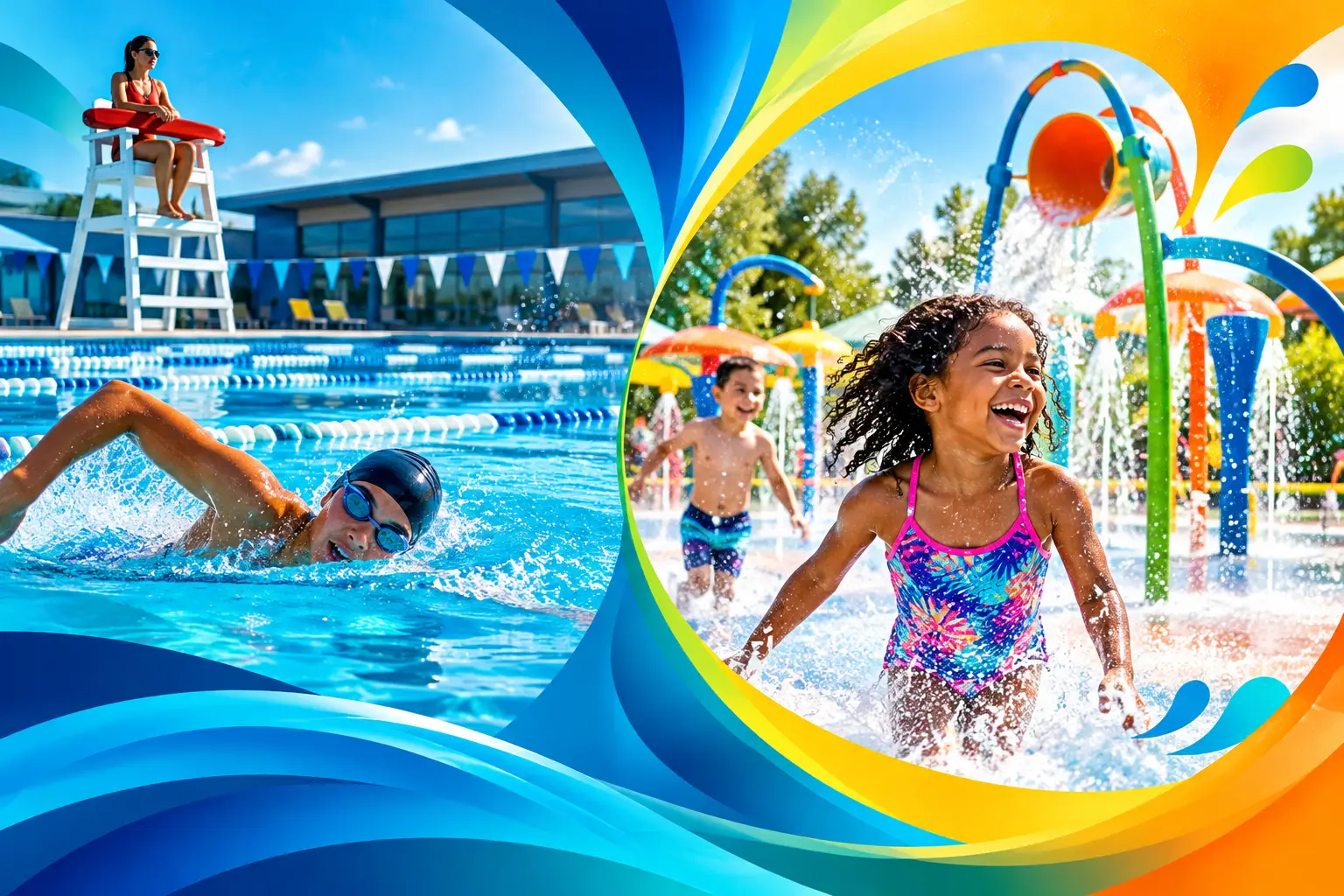
A family arriving at a recreation center on a hot afternoon may see a pool and a splash pad as two versions of the same amenity. For operators and community leaders, public pools versus splash pads is a much more consequential decision. Each serves a distinct purpose, carries different operational demands, and creates different opportunities for safety education, recreation, and community connection.
The strongest facility plans do not begin by asking which option is cheaper or more popular. They begin with a clear understanding of community need: Who will use the space? What aquatic outcomes matter most? Can the organization sustain the staffing, maintenance, programming, and safety systems required over time?
Public Pools Versus Splash Pads Start With Purpose
A public pool is an aquatic learning environment as well as a recreational destination. It can support swim lessons, lap swimming, water fitness, competitive programs, therapy, lifeguard training, school partnerships, and open recreation. Most importantly, a well-run pool creates repeated opportunities for people to develop water competency under qualified supervision.
That breadth comes with responsibility. Pools require appropriate staffing models, trained lifeguards, water-quality management, preventive maintenance, emergency action planning, and programming that matches the facility's design. They also require a long-term commitment from the organization that owns or operates them.
A splash pad is generally designed for accessible, low-depth water play. It can be an inviting point of entry for young children, caregivers, and residents who may not be ready for a traditional pool environment. Its open layout often supports casual social use, and its visual activity can energize a park, downtown space, or neighborhood recreation site.
But a splash pad does not teach people how to swim. It can introduce children to water, support positive family experiences, and complement water-safety messaging, but it should not be positioned as a substitute for aquatic instruction or supervised swimming opportunities. Communities seeking to reduce barriers to water competency need to recognize that difference early in the planning process.
Safety Is More Than the Depth of the Water
Splash pads are often described as safer because they do not include deep water. Lower water depth can reduce certain risks, but it does not remove the need for thoughtful design, active adult supervision, routine inspection, sanitation controls, and clear operating procedures. Wet surfaces, crowded play features, hot pavement, drainage concerns, and water-quality issues still require attention.
For public pools, safety is built through layers of protection. These include facility design, trained and attentive lifeguards, clear bather expectations, swimmer assessment practices, reliable communication systems, well-maintained equipment, and an organizational culture that treats training as an ongoing responsibility rather than a once-a-season task.
The supervision model is one of the clearest differences. A pool with lifeguards provides a defined professional surveillance function, although caregivers still remain responsible for children in their care. A splash pad may operate without lifeguards depending on local requirements and operating decisions. That can reduce staffing needs, but it also changes how facilities communicate caregiver supervision expectations and respond to incidents.
Facility leaders should avoid making broad safety assumptions based solely on a feature type. A better question is: What hazards exist in this environment, and what systems will reliably manage them? Local health codes, building requirements, accessibility standards, and operating regulations should guide final decisions.
Operations and Staffing Shape Long-Term Success
The visible cost of construction is only one part of a facility decision. Public pools commonly demand greater investment in trained personnel, mechanical systems, chemicals, utilities, repairs, insurance, and ongoing capital renewal. A pool that is built without a realistic operating plan can become a strain on the very community it was intended to serve.
At the same time, a pool may generate significant public value that is not easily captured in a simple revenue-and-expense comparison. Swim lessons, team rentals, instructional partnerships, fitness programs, and community events can expand both use and mission impact. Strategic scheduling can help facilities serve multiple groups throughout the day rather than relying only on seasonal open swim attendance.
Splash pads may have a lower staffing burden and can often operate in locations where a full pool would not be feasible. However, they are not maintenance-free. Operators still need plans for water treatment or recirculation, filtration, feature inspections, surface upkeep, winterization where applicable, repairs, documentation, and opening and closing procedures. A closed splash pad in the middle of summer can quickly affect public confidence.
Staffing decisions should also reflect the intended guest experience. A splash pad may not require lifeguards, yet it may benefit from attendants, park staff, or trained seasonal personnel who can monitor conditions, communicate rules, respond to concerns, and report maintenance issues promptly. The right model depends on site layout, attendance patterns, nearby amenities, local requirements, and available resources.
Plan for the full life cycle
Boards and funding decision-makers should ask for a life-cycle view before approving either asset. That means considering design, construction, commissioning, training, daily operation, maintenance, replacement schedules, and eventual renovation. Deferred maintenance is not a strategy. It simply shifts costs and can limit the facility's ability to deliver safe, dependable service.
A practical planning process also identifies who owns each responsibility. If parks staff, public works teams, contracted vendors, aquatic staff, and community partners all touch the operation, roles should be documented before opening day. Clear accountability prevents small issues from becoming prolonged closures or safety gaps.
Access, Inclusion, and Community Need
Splash pads can be especially valuable where families need free or low-cost outdoor recreation close to home. They may be easier for caregivers with very young children to use, and inclusive design can make the experience more welcoming for people with varied mobility, sensory, and developmental needs. Shade, seating, pathways, restrooms, changing areas, and transit access often matter as much as the water features themselves.
Public pools can serve a broader age range and a wider set of community goals. A shallow-water area supports introductory play and lessons. Deeper water supports swimming, training, and recreation for older youth and adults. Thoughtful programming can create space for people who are often overlooked in traditional schedules, including teens, older adults, adaptive participants, and families seeking affordable skill-building opportunities.
Neither facility type is automatically equitable. A splash pad that is difficult to reach, lacks shade, or is open only during limited hours may leave out the residents it was meant to serve. A pool with high admission fees, restrictive schedules, or insufficient lesson capacity may also fall short of its mission. Community engagement should inform decisions before design is finalized, not after a ribbon cutting.
When a Combined Approach Makes Sense
In many communities, the choice is not strictly public pools versus splash pads. A combined aquatic environment can offer a stronger continuum of experience. A splash-play area adjacent to a pool can engage younger children while siblings participate in lessons or open swim. It can also create a welcoming first encounter with water for families who may later enroll in instruction.
The combined approach succeeds only when operations are coordinated. Leaders need to consider traffic flow, supervision zones, restroom access, caregiver communication, maintenance capacity, and whether the splash area strengthens or distracts from the pool's core programs. Design should support the staff who will operate the space every day, not just the opening-week photographs.
For smaller communities, a splash pad may be an appropriate first investment when resources cannot support a full aquatic facility. That decision can still be paired with a broader water-safety strategy, such as partnerships for swim lessons, transportation to regional pools, school-based education, or seasonal instructional programs. A splash pad can be part of the solution without being presented as the whole solution.
Make the Decision With a Community Service Lens
The best facility decision aligns the asset with a defined public purpose. If the primary goal is water competency, instruction, fitness, and supervised swimming, a public pool offers capabilities a splash pad cannot replace. If the goal is accessible outdoor play for young families in a space with limited operational capacity, a well-maintained splash pad may be the better fit.
Before moving forward, leaders should document expected users, desired programs, seasonal demand, staffing availability, operating funding, maintenance responsibilities, and measurable community outcomes. Those conversations are often more valuable than debates about which amenity is trendier.
Aquatic facilities are community assets, and each one should be designed to do more than move water. Whether a community builds a pool, a splash pad, or both, the lasting measure of success is whether the space remains safe, welcoming, well-operated, and connected to a larger commitment to water safety and opportunity.