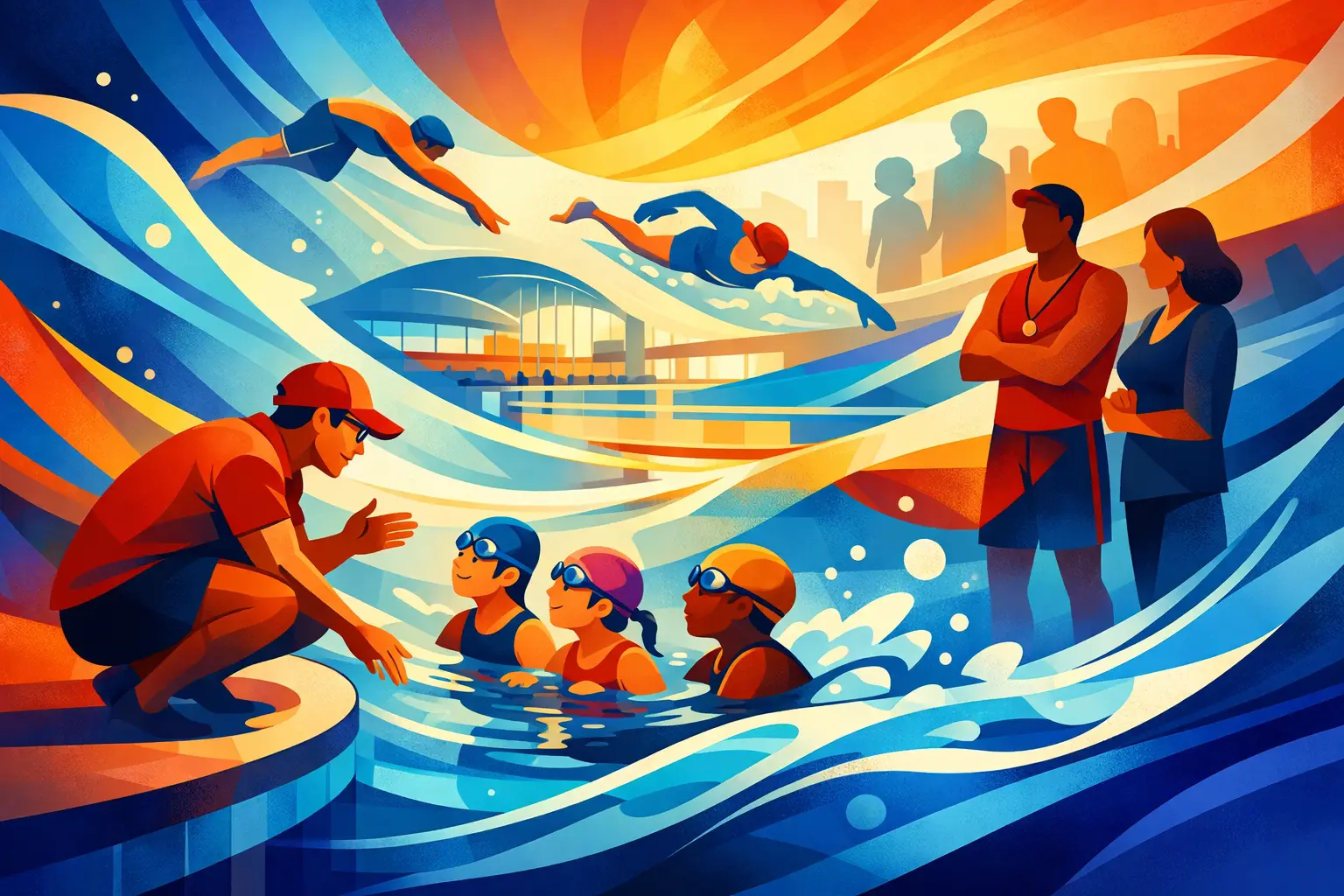
A child who can repeat a skill in one lesson but cannot use it confidently in a new setting has not yet gained reliable water competency. That distinction is central to what makes swim lessons effective. Effective lessons do more than fill class time or move participants through a checklist. They build practical skills, sound judgment, confidence, and safer habits through instruction that is intentional, progressive, and accessible.
For aquatic professionals and community leaders, the question is operational as well as educational. Lesson quality affects participant retention, staff development, program reputation, equitable access, and the broader community goal of reducing water-related risk. A strong program is not defined by the number of classes offered. It is defined by whether participants are learning skills they can retain and apply.
What Makes Swim Lessons Effective?
The strongest swim lesson programs align four elements: qualified instructors, purposeful lesson design, safety-focused teaching practices, and consistent opportunities to learn. If one element is weak, outcomes can suffer. A well-designed curriculum cannot compensate for an instructor who has not been prepared to teach it, and an excellent instructor cannot fully overcome classes that are too large, too infrequent, or poorly matched to participants' needs.
Effective programs also recognize that swimming is learned over time. Progress is rarely linear. Some participants need repeated exposure before they are comfortable submerging, floating, or moving independently. Others gain early confidence but need continued practice to develop endurance, self-rescue skills, and sound decision-making. Programs should make room for both patterns rather than treating a single timeline as the standard for success.
Skilled Instruction Turns a Curriculum Into Learning
A curriculum provides structure, but the instructor determines how that structure reaches each learner. Instructors need more than the ability to demonstrate strokes. They need to observe readiness, communicate clearly, manage a group, maintain active supervision, and adjust instruction without losing sight of the lesson objective.
Clear objectives and simple feedback
Each lesson should have a defined purpose. Participants and instructors should know whether the session is focused on breath control, floating, changing direction, coordinated movement, water entry, or another specific skill. When too many skills are introduced at once, learners may be active without making meaningful progress.
Feedback is most useful when it is immediate, specific, and manageable. Rather than telling a participant to "swim better," an instructor can identify one action: look down, keep the body long, blow bubbles before lifting the face, or reach toward the wall. Small corrections give learners a practical next step and help instructors see whether the teaching approach is working.
Appropriate grouping matters
Age alone is not enough to create effective groups. Participants may be the same age but arrive with very different comfort levels, prior experience, physical abilities, and learning needs. Thoughtful placement allows instructors to pace lessons appropriately and reduces the likelihood that a participant will feel rushed, overlooked, or bored.
Facility leaders should review instructor-to-participant ratios with the actual instructional environment in mind. Water depth, participant age, skill range, teaching space, available equipment, and the need for hands-on support all affect what a manageable class looks like. Lower ratios may be necessary for beginners, young children, participants with additional support needs, or classes in which close physical assistance is expected.
Effective Lesson Design Builds Skills in Sequence
Good lessons are planned around progression, not around keeping every minute busy. A participant generally needs comfort and control in the water before more advanced movement becomes productive. Skills should build from foundational abilities toward increasingly independent and adaptable performance.
A practical sequence often includes safe entries and exits, breath control, buoyancy, body position, floating, rolling or changing orientation, forward movement, and movement to a point of safety. As participants advance, instruction can address distance, stroke development, treading, deep-water readiness, and decision-making in different aquatic environments.
The order may vary by program and learner, but the principle remains the same: new skills should connect to skills already practiced. Asking a participant to perform a coordinated stroke before they can comfortably place their face in the water often creates frustration rather than progress.
Practice must also be frequent enough to support retention. A once-a-week class can be valuable, particularly when it is part of a sustained program, but it may require more sessions for learners to build consistency. Short-term intensive programs can accelerate familiarity and practice time, yet they may not fit every family's schedule or every facility's staffing capacity. Program design should account for these trade-offs rather than assuming one format serves all learners equally well.
Safety Is Part of Instruction, Not a Separate Add-On
Water safety education works best when it is integrated into every lesson. Participants should learn how to enter and exit safely, recognize their own limits, respond when they feel tired or uncomfortable, and move toward a point of safety. These lessons should be taught calmly and repeatedly, not presented as a one-time warning.
Effective programs also maintain clear separation between instructional practices and supervision responsibilities. Instructors must be able to teach while maintaining appropriate awareness of every participant. Lifeguards, where present, have distinct duties that should not be diluted by informal expectations to assist with lesson delivery. Clear staffing plans, defined zones, and consistent communication support both learning and safe operations.
Facilities should prepare instructors for common moments that interrupt instruction: a participant refusing to enter the water, a child becoming anxious, a group drifting out of position, or a learner needing a skill modified. Preparation helps staff respond with patience and control instead of improvising under pressure.
Access and Belonging Shape Outcomes
A lesson cannot be effective for a community if large parts of that community cannot attend, afford, reach, or feel welcome in it. Schedule design, transportation barriers, fee structures, language access, adaptive programming, and family communication all influence participation.
This does not mean every program must offer every service immediately. It does mean leaders should examine who is absent from their programs and why. Partnerships with schools, parks and recreation departments, housing organizations, community groups, and local funders can help expand access in ways a facility may not be able to accomplish alone.
Belonging also affects learning. Participants are more likely to return and persist when staff communicate respectfully, explain expectations clearly, and create an environment where questions are welcomed. Families should understand what their participant is learning, what progress may look like, and why continued participation matters. A certificate can recognize an achievement, but it should not be the only measure of readiness.
Measure Progress Beyond Class Completion
Enrollment and completion numbers are useful operational measures, but they do not show whether learning occurred. Effective programs use skill-based assessment to determine what participants can do with appropriate independence, consistency, and control.
Assessment should be practical and aligned with program goals. Can the participant recover to a float? Can they move a meaningful distance using an appropriate method? Can they orient toward an exit or other point of safety? Can they perform the skill under conditions that are similar to, but not identical to, the way it was taught? The answers help instructors make better placement decisions and help program leaders identify where curriculum or staffing adjustments may be needed.
Facilities should also look for patterns across classes. If many participants struggle at the same point, the issue may not be individual effort. It may indicate that the skill sequence needs refinement, staff need additional training, class sizes are limiting feedback, or families need clearer guidance about attendance and practice.
Professional development supports this continuous improvement process. Observing lessons, reviewing incident and near-miss procedures, discussing participant behavior, and sharing teaching strategies strengthen consistency across the team. Organizations such as Total Aquatic Education and Training Institute can help aquatic professionals connect training and research to the daily realities of pool operations and community programming.
The most effective swim lessons leave participants with more than a completed level. They leave them better prepared to make thoughtful choices around water, continue developing their skills, and see aquatic spaces as places where safety, confidence, and community can grow together.